Keeping the faith
Nov 16, 2026

Believing in yourself when things don't go to plan
The kiln can be a cruel master when it comes to taking pottery from idea to reality. You have a creative idea, plan it out, research techniques, practice those techniques, and then what you produce isn't what you hoped for, and ceratinly not what you planned.
So many things influence the final piece. The colour of the clay, the colour of the glaze and how those two things interact, the position of the piece in the kiln and how those three things interact. Glaze consistency, commercial glaze, handmade glaze, where on the piece is the glaze applied and how does that compare to your test tiles. Did you do test tiles? Is it a single firing or has the piece been bisqued? The type of firing. The temperature of the firing. On and on and on!
I'm not in charge of firing my pieces. I don't currently own a kiln, so I use a firing service. I have no control over where in the kiln the pieces go or even the precise firing temperature (I know they get fired to stoneware temperatures, e.g. cone 9-10, but it doesn't get more precise than that).
Then there are all of the things that can go wrong. Bloating, shivering, crazing, crawling, pinholes, dunting and pitting. While crazing is sometimes specifically created for its aesthetic affect, the rest are usually unwanted, are unsightly, if they turn up on functional ware, can render the piece no longer food safe, or just ruin the piece entirely.

An example of bloating (the bubbles) and crazing (the “cracks” in the glaze) on the same piece. While I don't mind the crazing, it wasn’t actually wanted on this piece 😒
Finally, theres’s a piece that just doesn’t come out the way you’d hoped. The form is good, the firing went well, glazes came out true to form, but the piece is simply…uninspiring. There’s a market out there for everything, but when you don’t love something, or it doesn’t meet your aesthetic expectations, it can be hard to want to put it out there into the world. I have some pieces like that.
Just when I think I've tested all the things I need to test, a piece (or more) comes out of the kiln that disappoints. My most common and most disappointing defect is crawling. It usually happens when I single fire a piece and I've used a commercial glaze. Many commercial glazes are not designed to go onto greenware and this can cause problems if you prefer to single fire. But quite often, using a commercial glaze is how most of us start. Because I currently use a firing service, I have to pay for each firing, which means I can halve the firing costs if I single fire, and that has flow-on effects to retail costs (for when I eventually start selling). Some of these defects can be fixed with a re-firing, but if you don’t own your own kiln and you are paying for a firing service, the cost of re-firing quickly adds up. And if you don’t refire? Then the only option for some pieces is the bin. Also ultimately an expensive option.
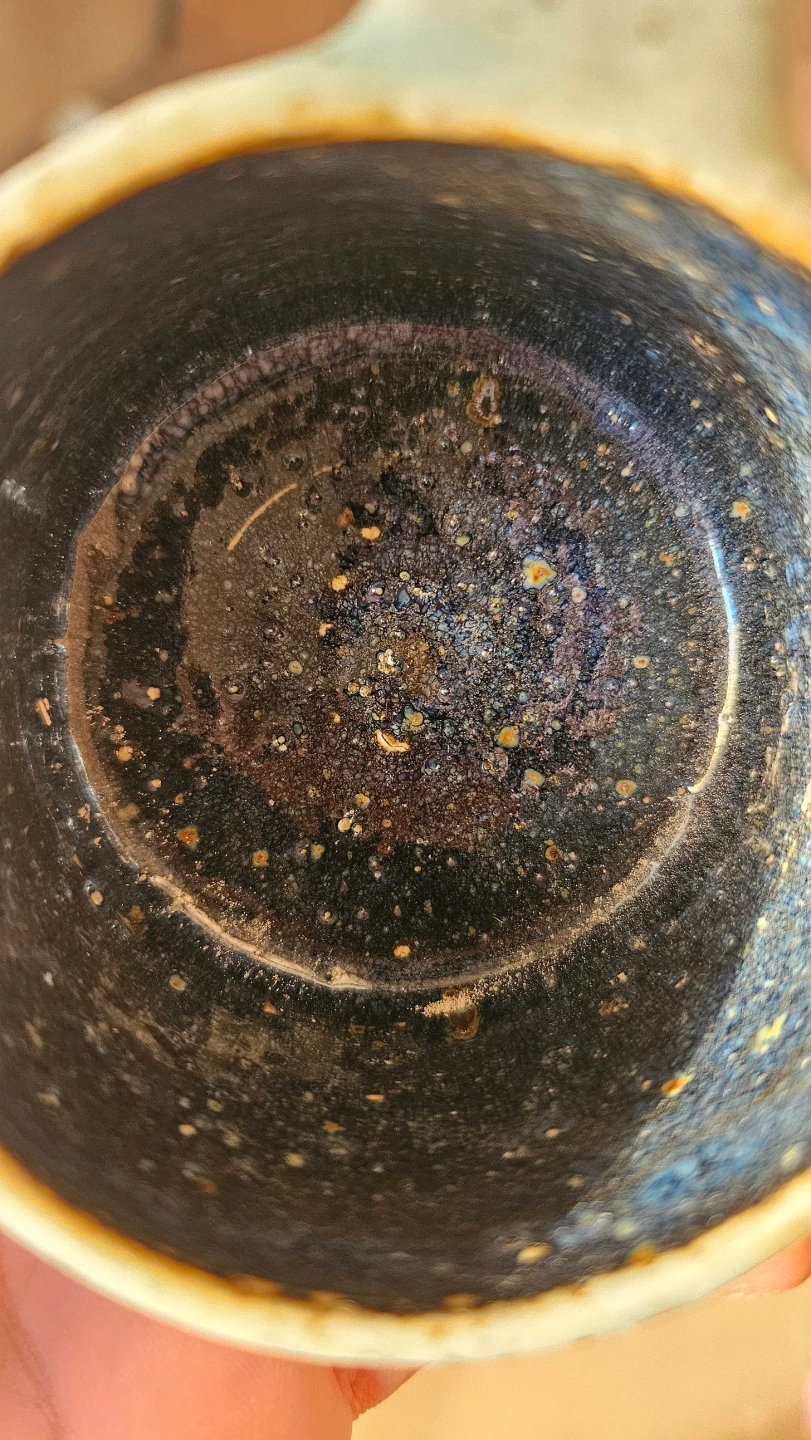

The inside of this single-fired cup (using a commercial glaze) has pinholes, pitting and a little bit of crawling. It's bumpy and crackly to the touch. Not a good thing to have on piece that's going to come in contact with food.
These problems don’t happen all of the time, but when you get a batch back from firing and most are affected by any one of these problems it can be frustrating and disheartening. It can feel like you don’t have the skills to make this work, that you’re wasting your time (and money) and that you’ll never be good enough to be able to sell anything. It’s at these times that you need to be kind to yourself. Especially when you are a beginner. There is so much to learn about pottery, it is inevitable that as a beginner, things will not go to plan. That doesn’t mean things will never go to plan, it just means there’s more to learn. It’s OK to be disappointed.
Today, I need to be kind to MYself. Some of the peices I recently picked up are perfectly functional but just aren’t to my liking (probably the worst kind of disappointment). Some have defects and need to be re-fired. Even then, they may not be saved.
The defect pieces will go into a box and wait until I have finished building my own kiln. They’re small and will make good fill pieces to pack the kiln with. As for the functional but disappointing pieces, I’m not sure yet. Some might end up with plants in them in the garden, some might get used in the studio and some might end up in the shop as seconds or simply donated. It seems a waste to bin them.
So what to do after such a disappointing batch? Well, it's confirmed for me that I should do that online glaze course I've been thinking about. Getting into the chemistry of glazes should help me understand why the glazes are behaving the way they are, and more importantly, how I can fix them. While I can't fix a commercial glaze (no recipes for those), I can certainly make my own glazes fit better. Finishing building my kiln is also climbing higher up the priority list. That will come with its own challenges (it’s a woodfire kiln), but at least it will be a challenge that I have some control over. Finaly, it’s simply time to pick myself up from this disappointment and practice more. Time to get back into the studio and make, and make, and make. Time to keep building my skills and learning from my mistakes. It is the only successful way forward.
So if you come across these issues on your own pottery journey, don't despair. You're not the first and you certainly won't be the last. If you don't like to experiment, then follow the rules of your commercial glaze and you should have much better outcomes. But if, like me, you like to cut your own path and consider rules more like very loose guidelines 😉 then failure is expected and is an opportunity for learning and growth. Sometimes, I just need a whole blog post to remind myself of that
❤️